Revolution in Andhra Pradesh(T. Ravisankar, C.V. Sairam, R. Geetha, Akshaya Panigrahi, and M. Kailasam)
Andhra Pradesh is the undisputed engine of Indian aquaculture, producing over 630,000 metric tonnes of Penaeus vannamei shrimp each year nearly 70% of the country’s total farmed output. Yet beneath this impressive harvest lies a precarious reality: almost the entire volume is funnelled into volatile global commodity export markets. Faced with falling real dollar prices, mounting feed and energy costs, and steep intermediary markdowns, primary producers find their margins squeezed to the brink. A blue print for “Igniting Domestic Shrimp Marketing Revolution in Andhra Pradesh” is proposed in this article. A transformative domestic alternative is within reach. In Phase I, launching a distributed network of 1,000 refrigerated, digitally managed micro-retail kiosks dubbed “Shrimp ATMs” across transit hubs, fuel stations, and urban neighbourhoods, Andhra Pradesh can unlock a ₹402 crore domestic retail market. This micro-retail strategy creates a stable, high-margin domestic demand sink that protects farmers from international commodity price swings.
The Export Volume Trap: Currency Illusion and Margin Compression
At first glance, Andhra Pradesh’s aquaculture sector appears to be expanding rapidly. Official MPEDA records show 71,921 hectares under P. vannamei culture generating 634,672 metric tonnes (MT) annually at a robust 8.82 MT/ha/year, alongside 2,591 hectares yielding 5,222 MT of black tiger shrimp (Penaeus monodon).
| Gross Export Volume: ~634,672 MT (P. vannamei) |
| ├── Upstream Import Leakage (-20% to -25%): SPF broodstock, marine protein feeds, additives |
| ├── Intermediary Capture (-35% to -40%): Overseas repackaging, external logistics, retail rents |
| ├── Inflexible On-Farm OPEX (-20% to -25%): Grid power, diesel aeration, biological upkeep |
| └── Net Producer Surplus: Residual <5% to 10% |
However, double-digit growth in nominal rupee earnings is largely an accounting illusion. The Indian Rupee’s depreciation against the US dollar has added a superficial 8% to 10% translation boost, masking the fact that realized global USD unit prices have declined by 6% to 10%.
At the same time, Indian farmers are caught in a global volume squeeze. Ecuador’s large-scale ponds and automated feeding achieve production costs of $2.80 to $3.40 per kilogram, consistently undercutting India’s smallholder cost base of $3.80 to $4.30 per kilogram.
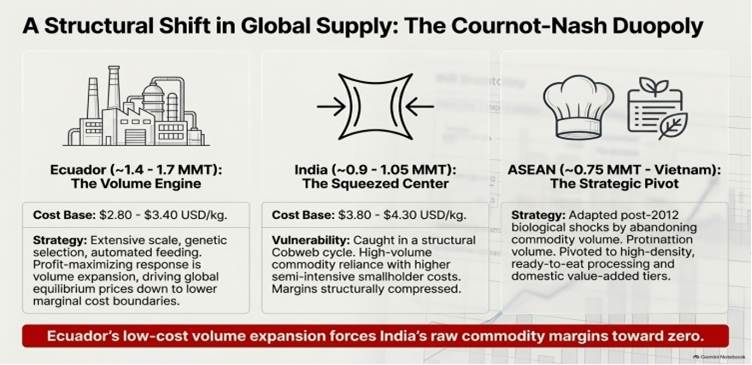
Meanwhile, Southeast Asian competitors like Vietnam have shifted away from raw bulk shipping to focus on lucrative ready-to-eat products. Compounding the problem, export intermediaries immediately pass 100% of global price downturns onto local farmers, but pass through less than 60% of market rebounds while rebuilding corporate reserves.
The Big Idea: Put Shrimp Where People Already Are-Indian City Corridors
As Andhra Pradesh is the engine of shrimp production it is better to start with big push on domestic shrimp marketing from there itself. The following sections high light the idea, feasibility and doablity. First of all AP can send huge amount of domestic shrimp production to major metros as it is well connected by existing transport system.
Secondly, rather than asking consumers to navigate crowded, unorganized wet markets, the Shrimp ATM concept brings fresh, hygienic seafood directly into daily routines. The schematic plan with details as given in figure below.
The last mile link to consumer is by modern kiosks. Each kiosk functions as an automated or semi-automated, IoT-enabled retail node featuring continuous cold-chain temperature tracking, automated inventory management, and digital point-of-sale systems.
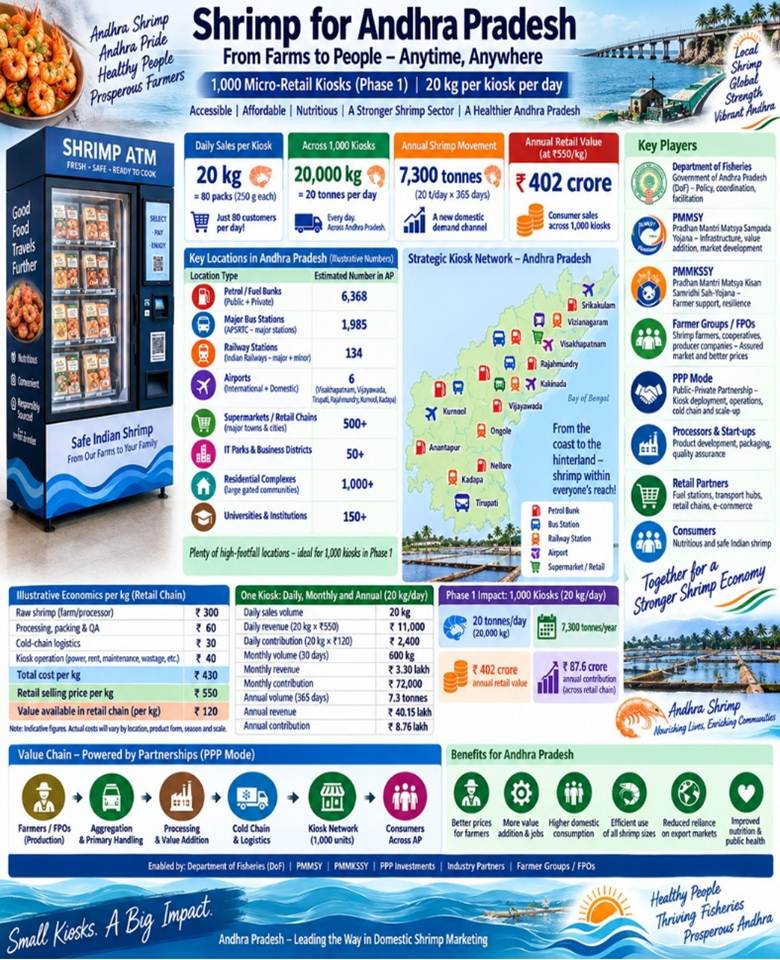
Phase I envisions deploying 1,000 kiosks across Andhra Pradesh by tapping into selected points of more than 25,000 existing commercial real estate and transport hubs:
* Fuel Stations (6,368 sites across AP): Capitalizes on daily vehicular refuelling and quick evening commuter stops.
* Major Bus Terminals (1,985 APSRTC stations): Accesses steady, high-density intercity and rural foot traffic.
* Gated Residential Communities (10,000+ complexes): Delivers clean, ready-to-cook protein directly to suburban doorsteps.
* Supermarkets and Modern Retail (5000+ outlets): Engages quality-conscious shoppers looking for verified, hygienic meats.
* Universities and Campuses (150+ institutions): Caters to campus faculty housing and institutional dining needs.
* Major Railway Stations (134 stations): Reaches busy transit passengers across primary urban corridors.
* IT Parks and Commercial Hubs (5000+ centres): Serves working professionals looking for quick, convenient dinner options.
The Power of Micro-Selling Economics
A single kiosk selling 20 kilograms a day may seem modest, but aggregating hundreds of these micro-transactions creates a massive domestic market.
Single Kiosk Baseline: 20 kg/day = 80 retail packs (250g each)
└── Across 1,000 Distributed Kiosks:
├── Daily Network Volume: 20,000 kg (20 tonnes/day)
├── Annual Network Throughput: 7,300 tonnes/year
├── Annual Retail Value (at ₹550/kg): ~₹402 Crore/year
└── Downstream Retained Margin (at ₹120/kg): ~₹87.6 Crore/year
Unit Cost and Margin Breakdown (per kg)
| Cost Component / Margin Node | Rs / kg | Operational Description & Assumptions |
| Raw Shrimp (Farmgate / Processor Cost) | Rs 300 | Fair farmgate price ensuring smallholder operating surplus. |
| Processing, IQF Freezing, Packaging & QA | Rs 60 | De-heading, peeling, deveining, IQF, vacuum tray packing, digital QA. |
| Cold-Chain Distribution | Rs 30 | Temperature-controlled reefer logistics from AP hubs to kiosks. |
| Kiosk Operations, Power, Maint. & Wastage | Rs 40 | Electricity, kiosk rental/lease share, maintenance provision, shrinkage. |
| Total Cost per kg | Rs 430 | Full land-at-kiosk cost base. |
| Illustrative Retail Selling Price | Rs 550 | Competitive pricing against urban mutton/fish retail benchmarks. |
* Value Captured in Distribution Chain: ₹120/kg
At 20 kg per day, an individual kiosk generates ₹2,400 daily (around ₹72,000 per month) in gross margin contribution before central overheads. Scaled across 1,000 units, the network circulates ₹87.6 crore annually within the local processing and retail ecosystem.
Product Innovation: “Dinner in 10 Minutes”
Developing a domestic consumer base requires abandoning the export sector’s bulky 2-kilogram frozen blocks in favour of formats designed for everyday Indian kitchens:
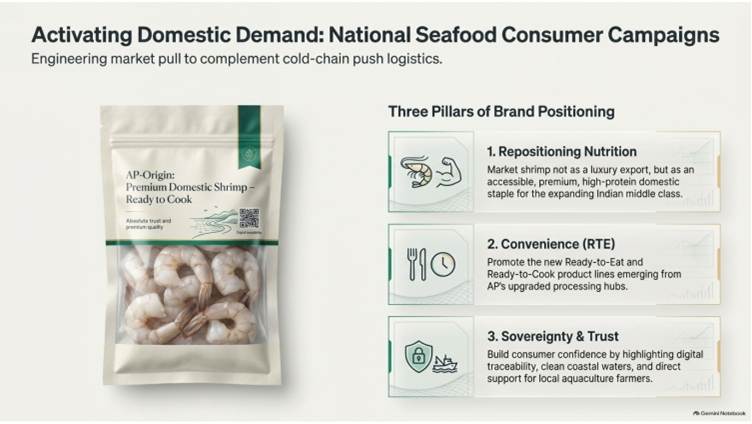
Accessible Entry Packs: Sealed 100g, 200g, 250g, and 500g zipper pouches bring single-meal purchase costs down to ₹130–₹150, removing price barriers for first-time buyers.
Ready-to-Cook (RTC) Convenience: Peeled and deveined (PD), Individually Quick Frozen (IQF) shrimp, marinated cuts, and ready-mix biryani and curry kits reduce prep time to zero.
Ready-to-Eat (RTE) Value Addition: Cooked finger foods, including shrimp cutlets, dumplings, samosas, and regional pickles, appeal directly to busy households.
Repositioning Smaller Counts: Smaller shrimp sizes, which often face steep price discounts in export markets, can be branded under the banner “Dinner in 10 Minutes” as fast-cooking essentials for daily curries and fried rice.
Public-Private-Producer Partnerships (PPPP)
Rolling out automated micro-retail across the state relies on clear collaboration between government bodies, farmer collectives, and commercial operators:
| Stakeholder Group | Core Strategic Responsibilities & Alignment |
| Department of Fisheries / State Govt. | Policy facilitation, standard setting, quality convergence, and enabling infrastructure subsidies. |
| PMMSY (Pradhan Mantri Matsya Sampada Yojana) | Capital convergence for reefer transport, processing hub upgrades, and kiosk infrastructure grants. |
| PM-MKSSY (PM Matsya Kisan Samridhi Sah-Yojana) | Formalisation of microenterprises, supply chain efficiency, quality assurance, and digital onboarding. |
| Farmer Groups / FFPOs / Cooperatives | Direct supply aggregation, eliminating multi-layered intermediary markdowns, and sharing downstream profits. |
| Processors & Private Investors | Advanced IQF processing, packaging, IoT kiosk deployment, cold-chain operations, and brand marketing. |
| Location Partners | Site access across fuel stations, transport hubs, supermarkets, and residential complexes. |
Every kiosk also doubles as a real-time market research terminal. Digital point-of-sale data captures granular patterns in pack sizes, flavour preferences, peak buying hours, and repeat sales, turning the network into a statewide consumer research lab. On-pack QR codes trace each batch back to its farm and processing date, building trust in product safety and freshness.
Connecting Hubs: Metro Logistics and Upstream Reform
The Andhra Pradesh kiosk rollout establishes the baseline for wider national distribution. Subsidized cold-chain logistics corridors will connect primary coastal processing clusters directly to high-purchasing-power urban markets:
To support downstream retail growth, state and national aquaculture policy should incorporate key supply-side reforms:
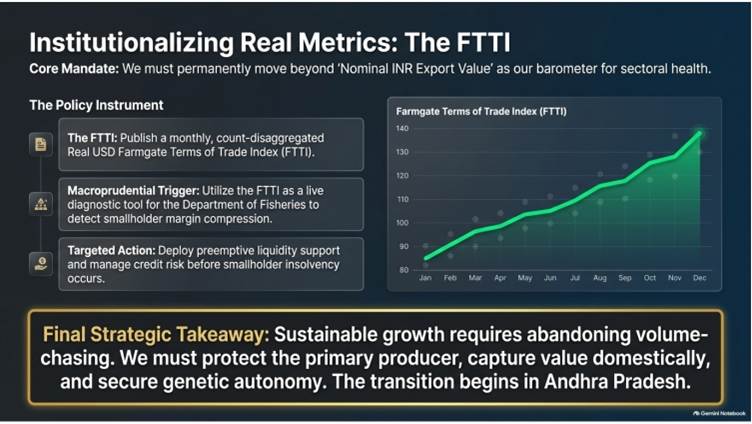
- Institutionalize a Farmgate Terms of Trade Index (FTTI)
- Replace nominal export turnover figures with a monthly, count-disaggregated FTTI.
Tracking real purchasing power allows policymakers to identify farmgate margin compression early and deploy liquidity before smallholders’ face insolvency.
(The authors currently serving at ICAR-Central Institute of Brackish Water Aquaculture. Views expressed are personal)
- Expand Domestic SPF Breeding: Broaden selective breeding programs for Penaeus indicus (Indian white shrimp) and P. vannamei to reduce reliance on imported American broodstock.
- Incentivize Alternative Feed Ingredients: Introduce Production Linked Incentives (PLI) for alternative proteins, single-cell ingredients, and insect meals, insulating farmers from global fishmeal price volatility that drives 55% to 65% of farm operational costs.
Conclusion
For decades, India’s aquaculture policy has focused exclusively on long-distance global supply lines. The Shrimp ATM model closes the loop with a shorter, more resilient domestic supply chain. By converting small daily retail purchases into steady macro-demand, Andhra Pradesh can safeguard producer livelihoods, keep processing margins within the state, and establish a clear blue print.